
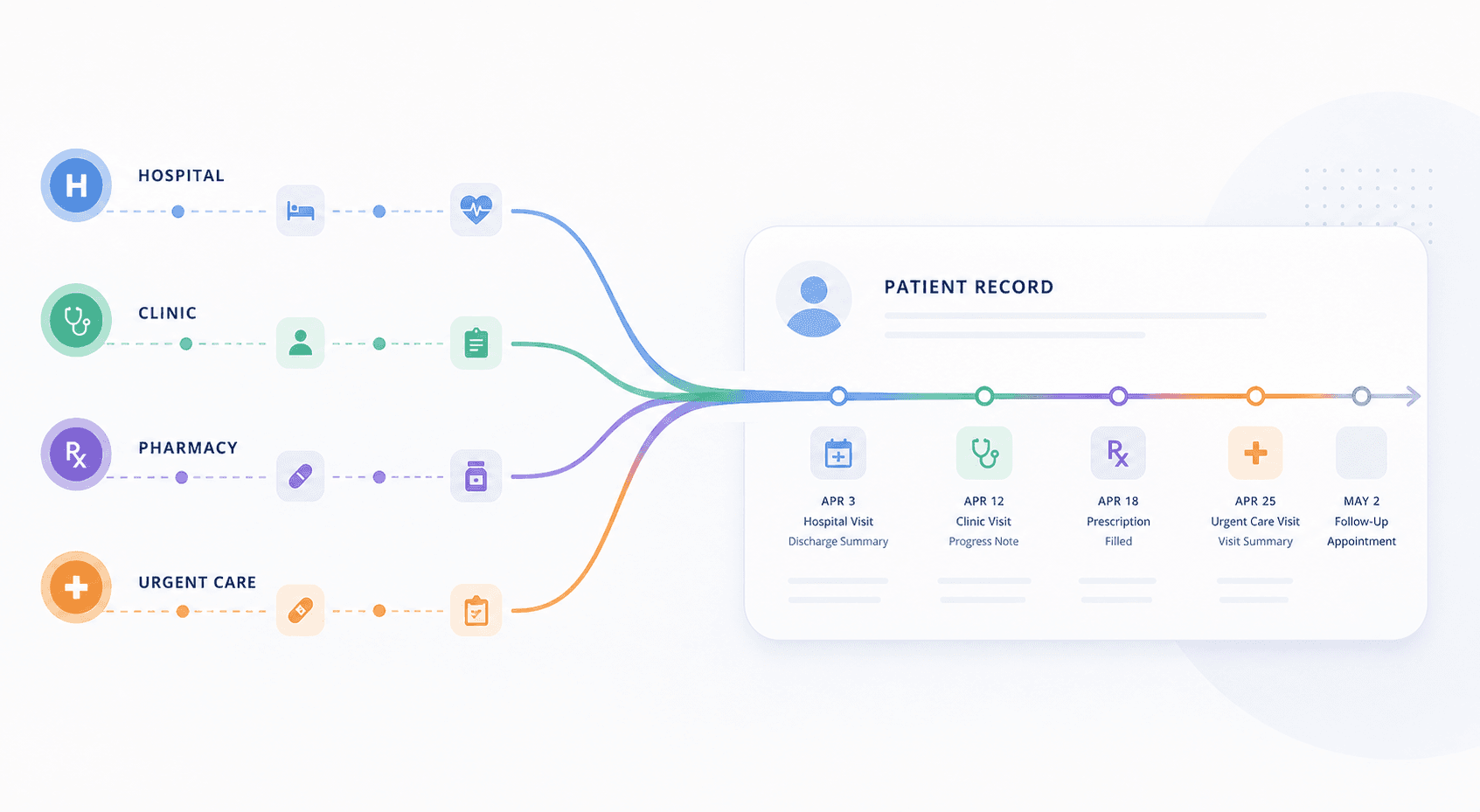
Your EHR captures what happened in your system. But your patients have been getting care long before they walked through your door, and they'll keep getting it at other places after. Building a real longitudinal patient record means solving for all of that, which turns out to involve a lot more than plugging systems together.
TLDR:
- A longitudinal patient record unifies a person's complete health history across every care setting into one time-ordered timeline, where an EHR captures only one institution's encounters.
- Over 3,000 EHR systems are in use today, meaning a single patient's data routinely lives across separate environments with no shared view.
- Social determinants of health carry more predictive weight on outcomes than clinical variables alone and live almost entirely outside the EHR, making clinical-only records incomplete for high-risk patients.
- Patient matching requires probabilistic algorithms and governed identity services because HL7 FHIR moves data between systems but does not confirm whether two records belong to the same person.
- Concurrence's Health World Model unifies EHR data, claims, public datasets, and social and environmental factors into one longitudinal view per patient, with corrections and prior evidence staying traceable as new information arrives.
What Is a Longitudinal Patient Record?
A longitudinal patient record is a single, unified, time-ordered view of one person's complete health history, assembled from data across every care setting and encounter over their lifetime. Clinicians sometimes call it a "womb to tomb" record, meaning it follows a patient from birth through their final encounter with the healthcare system.
The key word is unified. Each visit to a doctor, specialist, urgent care clinic, or hospital typically generates its own record, captured by whichever system that facility uses. An encounter-based record is a standalone snapshot with no thread connecting it to everything that came before or after. A longitudinal record pulls those snapshots into a single continuous timeline, so a clinician seeing a patient for the first time can understand that patient's full history instead of starting from scratch.
The goal, as it is broadly understood across the industry, is "a single complete patient record that combines data from a variety of sources throughout the healthcare system": one record per patient.
How a Longitudinal Patient Record Differs from an EHR
EHRs were a genuine step forward. Before them, patient notes were handwritten and locked inside filing cabinets. Digitizing that documentation made records searchable, portable within a system, and less dependent on any one clinician's memory.
But an EHR was architected to serve a specific institution, not to follow a patient across their life. As OneRecord notes, there are over 3,000 EHR systems in use, with roughly 10 dominating the market, meaning a patient's data lives scattered across separate environments with no single source of truth.
A patient who sees a cardiologist at one health system, a neurologist at another, and an urgent care clinic across town generates three separate records that may never speak to each other. Each system has a complete picture of its own encounters. None has a complete picture of the patient.
A longitudinal patient record, a core subject of Superintelligent Care, is what you get when those siloed records are unified into one continuous timeline per person. The EHR is the source of data, and the longitudinal record is the assembled result.
Key Characteristics of a Longitudinal Patient Record
Several characteristics separate a genuinely longitudinal record from a well-organized collection of encounter notes.
Single patient identity across systems
Every entry resolves to one confirmed person. When the same patient appears under slightly different names, birthdays, or locations across systems, the record links those entries correctly. Without consistent identity resolution, you end up with duplicate or split records instead of a unified timeline.
Time-ordered, multi-setting coverage
Events are sequenced chronologically across every care setting. A hospital admission, a follow-up visit at a separate clinic, a pharmacy fill, a lab result ordered elsewhere: all land on the same timeline for the same person.
Condition evolution over time
A snapshot shows what was documented on a given date. A longitudinal record shows how a condition developed, which treatments were tried, and what changed afterward, and that progression is what makes the record clinically useful beyond a single encounter.
Continuity of evidence, including corrections
A longitudinal record should preserve what was recorded alongside when it was recorded, when it was corrected, and what questions remain open, a capability closely related to functional memory. A revised diagnosis, a medication that was discontinued, a concern that was never resolved: these details carry clinical weight. Stripping them out in favor of a clean current view loses the reasoning that produced it.
What Data Goes Into a Longitudinal Patient Record?
Each source type contributes something the others cannot. Clinical notes and EHR data capture diagnoses, treatment decisions, and clinician reasoning. Claims data fills gaps across settings where a patient sought care outside your system. Lab and pharmacy records show what was ordered, what was dispensed, and what results came back. Imaging and procedure records document what was found and what was done. Patient-generated data from wearables or remote monitoring adds readings between visits. Registries and genomic data contribute population-level and inherited context that no single clinical system holds.
Social determinants of health, including housing stability, food access, transportation, and environmental exposures, are worth singling out, and representing those connections is part of what context graphs are built for. They often carry more predictive weight on outcomes than clinical variables alone, and they live almost entirely outside the EHR, which means a longitudinal record drawn only from clinical sources is incomplete in ways that matter most for the patients most at risk.
Longitudinal Patient Data vs. Cross-Sectional Data
| Dimension | Longitudinal Patient Data | Cross-Sectional Data | Time Series Data |
|---|---|---|---|
| What it tracks | The same individual repeatedly across encounters, decisions, and outcomes over time | A population or individual at a single point in time | A single variable measured repeatedly at regular intervals |
| Primary question answered | How has this person's condition changed, and what drove that change? | What does this population look like today? | What pattern or trend exists in this variable over time? |
| Can link interventions to outcomes? | Yes, connects care decisions to what happened next | No, a single time point cannot show whether a treatment changed a patient's outcome | Partially: detects trends but lacks the clinical context of decisions made in response |
| Typical use in healthcare AI | Risk prediction, disease progression modeling, comparative effectiveness research | Population-level correlation analysis, snapshots for audits | Anomaly detection, forecasting a single metric (e.g., HbA1c trend) |
| Example | A patient's labs, medications, diagnoses, and care events tracked over five years | Every patient's most recent HbA1c result across a practice | A patient's blood pressure readings from remote monitoring taken daily |
Cross-sectional data captures a population or individual at a single point in time. A clinical audit of every patient's most recent HbA1c result is cross-sectional. You get a useful snapshot of where things stand across a group, at one moment.
Longitudinal data follows the same individuals repeatedly over time. The question moves from "what does this population look like today?" to "how has this person's condition changed, and what drove that change?"
The clinical difference matters. Cross-sectional data can surface correlations, such as patients with a certain demographic profile having higher rates of a condition, but a single time point cannot tell you whether a treatment worked or whether an intervention changed what happened next. For that, you need repeated observations on the same patient, sequenced over time.
A study measuring cholesterol in a large population once can identify who has high cholesterol. A longitudinal record of those same patients over five years can show which of them developed cardiovascular events, which interventions were tried, and whether those interventions actually changed outcomes. That distinction matters most when the clinical question moves from correlation to causation. Cross-sectional data can tell you that a population with a certain profile tends to have worse outcomes; it cannot tell you whether a specific intervention, applied to a specific patient at a specific point in their condition's progression, produced a different result. Care planning and risk stratification both require that second kind of answer, which is only possible with repeated observations on the same individual over time.
Longitudinal Patient Data vs. Time Series Data
Time series data tracks a single variable measured repeatedly at regular intervals: hourly temperature readings, daily stock prices, or monthly revenue figures. The goal is usually to identify patterns, forecast what comes next, or detect anomalies in that one variable over time.
Longitudinal patient data shares the "repeated over time" quality, but the structure is fundamentally different. A longitudinal record follows a specific person across encounters, decisions, and outcomes, embedding clinical context beyond just measurements. A patient's journey through a chronic condition involves changing diagnoses, medication adjustments, care setting transitions, and clinician reasoning.
A longitudinal record can contain time series elements within it. A patient's hemoglobin A1c readings taken quarterly over several years form a time series, as do blood pressure readings from remote monitoring. But those series sit inside a richer structure that also includes the clinical decisions made in response to them, which interventions were tried, what the patient reported, and what happened afterward.
The practical distinction matters most in AI applications. A model trained on time series data alone can detect that a measurement is trending in a concerning direction, a limitation that also shows up in how healthcare AI handles real patient conversations. A model trained on longitudinal patient data can connect that trend to the care decisions and outcomes that followed, which is what you need to predict risk and inform what to do next.
Why Building a True Longitudinal Record Is Hard
Patient matching sits at the center of the problem. When the same person appears as "Robert Smith, DOB 1/4/1965" in one system and "Bob Smith, DOB 01/04/65" in another, the record either duplicates or fragments. Multiply that across a lifetime of care settings, and a unified timeline becomes genuinely difficult to assemble. Getting identity resolution right requires probabilistic matching logic, governance decisions about which source is authoritative, and ongoing reconciliation as records change. That is the same kind of groundwork behind how clinical agents get built and trained.

Data standardization compounds this. EHRs encode the same concepts differently, diagnoses use incompatible coding schemes across systems, and lab values arrive in formats that don't map cleanly to each other. Standards like HL7 FHIR help, but estimates suggest that 80-90% of healthcare data is unstructured and resides in disconnected systems. That share has not meaningfully declined over the past decade.
Missing data is an underappreciated issue. A patient who received care outside your network, filled a prescription at an out-of-network pharmacy, or simply never returned after a referral leaves gaps in the record. Those gaps are not neutral: they can look like absence of disease instead of absence of information, which produces different and wrong conclusions.
How Patient Matching and Record Linkage Work
Patient matching is the process of identifying and linking one patient's data within and across health systems to obtain a complete view of that patient's health care record, as defined by the ONC. At minimum, this involves linking demographic fields: name, date of birth, phone number, and mailing location.
In practice, matching relies on probabilistic algorithms that weigh how closely two records resemble each other across multiple fields. Small discrepancies (a transposed birth year, a nickname versus a legal name, a location change after a move) introduce uncertainty that the algorithm has to resolve. Errors in either direction carry real consequences. A false merge combines two patients into one record, while a false split creates duplicates for the same person. Both distort the longitudinal picture in ways that can affect care decisions downstream.
HL7 FHIR provides infrastructure for exchanging patient data across systems in a consistent format, but as ICF's analysis of patient identity notes, FHIR alone won't fix patient matching. Interoperability gets data moving between systems, a prerequisite for the vision of Superintelligent Care, but it does not resolve whether the person in system A is the same person in system B. That requires governed identity services, matching logic, and clear rules about which source takes precedence when records conflict.
Longitudinal Patient Records in Clinical Care
Continuity changes what a clinician can see. A physician encountering a patient for the first time, armed with only today's complaint and a few recent notes, works from an incomplete picture. The same physician with access to years of documented history across every care setting works from something closer to the truth.
The practical effects show up across several areas of clinical work.

Redundant Testing
When a clinician cannot confirm whether a lab was already run or whether imaging was ordered three months ago at a different facility, the default is often to reorder. A complete longitudinal record makes prior results visible and dateable, so the question "has this been done?" has an actual answer.
Medication Management
A patient seeing a cardiologist, a psychiatrist, and a primary care physician may receive prescriptions from all three, with no single prescriber holding the full medication list. A unified record surfaces the complete picture, which is the precondition for catching interactions before they cause harm across every workflow on a clinical platform.
Chronic Disease Management
Longitudinal data changes the nature of the clinical question. A clinician tracking a patient's diabetes over several years can see current control and how it has shifted in response to specific interventions, care gaps, and life events. That history informs what to try next in ways a current snapshot cannot.
Longitudinal Patient Records in Research and Population Health
Research needs longitudinal data for a straightforward reason: outcomes take time to appear. A drug trial ends, but whether that treatment changed a patient's health course over five years requires following the same people forward. Cross-sectional or claims-only snapshots cannot answer that question because they were never designed to.
Real-world evidence studies depend on this. When regulators and health systems want to understand how a treatment performs outside a controlled trial, in a messier population with comorbidities and variable adherence, they turn to longitudinal patient records. The same logic applies to comparative effectiveness research, where the goal is to identify which of two treatments produces better outcomes for which populations across settings and over time.
Disease progression modeling requires repeated observations on the same individuals at meaningful intervals. A model predicting which patients with early-stage chronic kidney disease will progress to dialysis within three years needs years of the same patients' labs, medications, and care events as its training set.
As researchers studying AI models for clinical decision support have found, longitudinal patient data is the necessary input for models that connect interventions to outcomes. Benchmark datasets like EHRSHOT exist precisely because single-visit data cannot test whether a model has learned anything about how patient health changes over time, which is part of why Concurrence partnered with Databricks on Health World Models.
Population health programs use longitudinal records to identify where care gaps open and close across defined groups, and which interventions closed them durably.
Privacy, Security, and Governance for Longitudinal Health Data
Aggregating health data across a lifetime of care encounters carries a different order of risk than managing a single encounter record. A longitudinal record is, by design, more complete than any individual source it draws from. That completeness is the point, and it is also where the privacy exposure concentrates.
Re-identification risk grows with record richness. A dataset containing only a diagnosis is relatively easy to de-identify, but a record linking that diagnosis to a specific care timeline, geographic history, medication sequence, and demographic profile becomes harder to strip of identifying information without also stripping clinical utility. Researchers have shown that seemingly anonymous longitudinal records can be re-identified by combining enough attributes, even without a name attached.
Regulatory Floors and De-identification Limits
HIPAA sets the floor for longitudinal data stewardship in the United States. Covered entities and business associates must apply the same protections to aggregated longitudinal records as to any other protected health information, including access controls, audit trails, breach notification requirements, and minimum necessary standards. Where de-identification is needed, HIPAA recognizes two methods.
- Safe Harbor requires removing eighteen specified identifiers from the record before it can be treated as de-identified.
- Expert Determination relies on statistical verification that re-identification risk is sufficiently low, assessed by a qualified expert.
Neither method is a complete guarantee when the underlying record is sufficiently detailed.
Consent and governance introduce their own complexity. A patient who consented to data sharing with one institution ten years ago may not have anticipated their records being unified across five systems and used to train a predictive model. Longitudinal data programs require clear governance frameworks specifying who can access which data, for what purposes, under what conditions, and with what retention limits, and a complete longitudinal record should also include a complete log of who accessed it and when and for what reason.
Data minimization is a useful discipline regardless of regulatory requirements. Pulling every available field into a longitudinal record because it might be useful differs from pulling fields because they serve a defined clinical or administrative purpose. Organizations that scope their data collection to documented purposes carry lower residual risk and simpler governance obligations than those that accumulate data speculatively.
How Concurrence Builds a Longitudinal Foundation for Healthcare Institutions
The Health World Model is how Concurrence builds that foundation. It unifies EHR data, claims, public datasets, and social and environmental factors alongside a customer's existing data infrastructure, whether that runs on Databricks, Snowflake, Azure, or another cloud, into one longitudinal view of each patient. Every piece of evidence entering the model is treated as a hypothesis tested against what is actually observed. When new information arrives, the patient picture revises, and earlier evidence, including corrections and unresolved questions, stays traceable and is never overwritten.
That design speaks directly to the two failure modes described throughout this article: records that are incomplete because data never arrived, and records that lose their clinical reasoning when a cleaner version replaces the original. AI-powered workflows deployed on top of that foundation read living context, not a stale snapshot, reflecting the Health World Model's living understanding of the patient. Interaction data flows back into the model within defined clinical protocols, making the record incrementally richer over time; the broader self-learning loop, including Patient Arcs, is an active research effort and not a currently shipped capability. To date, Concurrence has driven over 10 million patient interactions across that foundation. Integration covers Epic, Oracle Health, and Athenahealth natively, with SOC 2 Type II, HIPAA, and GDPR compliance in place.
Final Thoughts on Longitudinal Health Records and Their Role in Better Care
Your patients move across systems, change providers, and accumulate history that no single record captures on its own. Closing those gaps is a long-term effort, and starting with a clear picture of what a true longitudinal record requires puts you in a better position to do it.
FAQ
What is a longitudinal patient record, and how does it differ from a standard EHR?
A longitudinal patient record is a single, time-ordered view of one person's complete health history, unified across every care setting and encounter over their lifetime. An EHR captures what happened at one institution; a longitudinal record assembles those separate snapshots into one continuous timeline per patient, so a clinician has the full picture instead of one facility's slice of it.
What is longitudinal data in healthcare vs. cross-sectional data, and why does the difference matter for clinical AI?
Longitudinal patient data follows the same individuals repeatedly over time, connecting specific interventions to what happened next. Cross-sectional data captures a population at one moment, which can surface correlations but cannot answer whether a treatment changed a patient's health course. Clinical AI models trained on longitudinal data can connect trends to care decisions and outcomes; models trained on cross-sectional snapshots cannot, which matters directly for risk prediction and care planning.
What data sources should go into a longitudinal patient record?
A complete longitudinal record draws from EHR data, claims, lab and pharmacy records, imaging, patient-generated data from remote monitoring, and social determinants of health such as housing stability, food access, and transportation. Social determinants often carry more predictive weight on outcomes than clinical variables alone, yet they live almost entirely outside the EHR, making them one of the most common gaps in longitudinal data collection.
How does patient matching work across health systems, and why does getting it wrong distort the longitudinal record?
Patient matching uses probabilistic algorithms that weigh how closely two records resemble each other across demographic fields like name, date of birth, and mailing location. A false merge combines two different patients into one record; a false split creates duplicates for the same person. Both errors distort the longitudinal picture in ways that can affect care decisions downstream, and HL7 FHIR alone does not resolve them since interoperability moves data between systems without confirming whether the person in system A is the same person in system B.
Can I build a true longitudinal patient record on top of an existing EHR like Epic or Cerner?
An EHR like Epic or Oracle Health (formerly Cerner) is a necessary data source, but a longitudinal record requires more than what any single EHR holds. It takes governed identity resolution across systems, standardization of inconsistent coding schemes, and integration of claims, social determinants, and other non-clinical data that never enters the EHR. Concurrence's Health World Model is built to sit on top of existing EHR infrastructure, including native integrations with Epic, Oracle Health, and Athenahealth, unifying those sources into one longitudinal view without replacing the systems already in place.