
Every meaningful decision about a patient's care depends on someone having pieced together that patient's story. Why was a medication change deferred? Why did the pharmacist call? Why did the patient never start treatment? The next care team has to piece those answers together before deciding what to do.
When each care team has to rebuild that understanding, how can the organization learn from the care it has already delivered?
The ambition is for each encounter to contribute to a system that understands how a patient’s situation is changing and helps care teams anticipate what to do next. Over time, that foundation can support digital twins and simulations for exploring how different care decisions might change a patient’s trajectory.
Concurrence's Health World Model is designed to realize that ambition. It carries documented context about the patient and their care forward across encounters and organizations, revises that picture as new evidence arrives, and gives the next person or application making a decision that updated context to act on.
Keeping Up With the Patient Between Visits
No care team can stay with every patient around the clock, and a patient's condition continues to change between encounters. New symptoms, treatment delays, or barriers can reach different clinicians on different days, and their significance can get lost in the handoffs. Understanding why treatment stalls, and learning from how teams resolve it, can generate tested approaches that give future patients a better starting point.
For example, a patient with diabetes might be receiving care for an infected foot wound. A vascular assessment has recorded poor circulation, and the care team has agreed on a plan that includes treatment to address it. The wound and vascular visits have taken place, but that treatment remains outstanding. The patient keeps returning for wound care and dressing changes while managing restrictions on walking and the logistics of getting to appointments. The overall course of care makes limited progress.
With Concurrence, an automated follow-up call between visits captures the patient's report of poor wound progress and that the recommended vascular treatment has not yet happened. It also captures what that has meant day to day, such as arranging time away from work or transportation for repeated visits. The Health World Model connects that report to the documented wound course, the circulation findings, the clinician's rationale for the vascular plan, and the treatment that remains outstanding. The follow-up workflow then brings the patient's concern and that connected context to the care team for review.
From there, the care team verifies what has occurred, investigates the unresolved treatment step, and agrees on next actions with the wound and vascular specialists. Reassessment considers which parts of the full plan have happened, then addresses what is still incomplete alongside ongoing wound care. The aim is to move the patient toward recovery and reduce the time spent managing an unresolved wound, while the team tracks progress through the full treatment plan.
The next clinician uses the Health World Model to review the patient's care across connected teams and sources. The model shows how the patient arrived at the current state, which treatments they received, how the wound responded, and the documented reasoning behind today's plan. The system carries that history forward, relieving the patient of the burden of reconstructing a complex course of care from memory.
At scale, countless cases like this should compound what the organization learns about delivering care. A patient's challenges, the care decisions made, and what happened next inform improvements in care for future patients with similar needs.
How the Health World Model Works
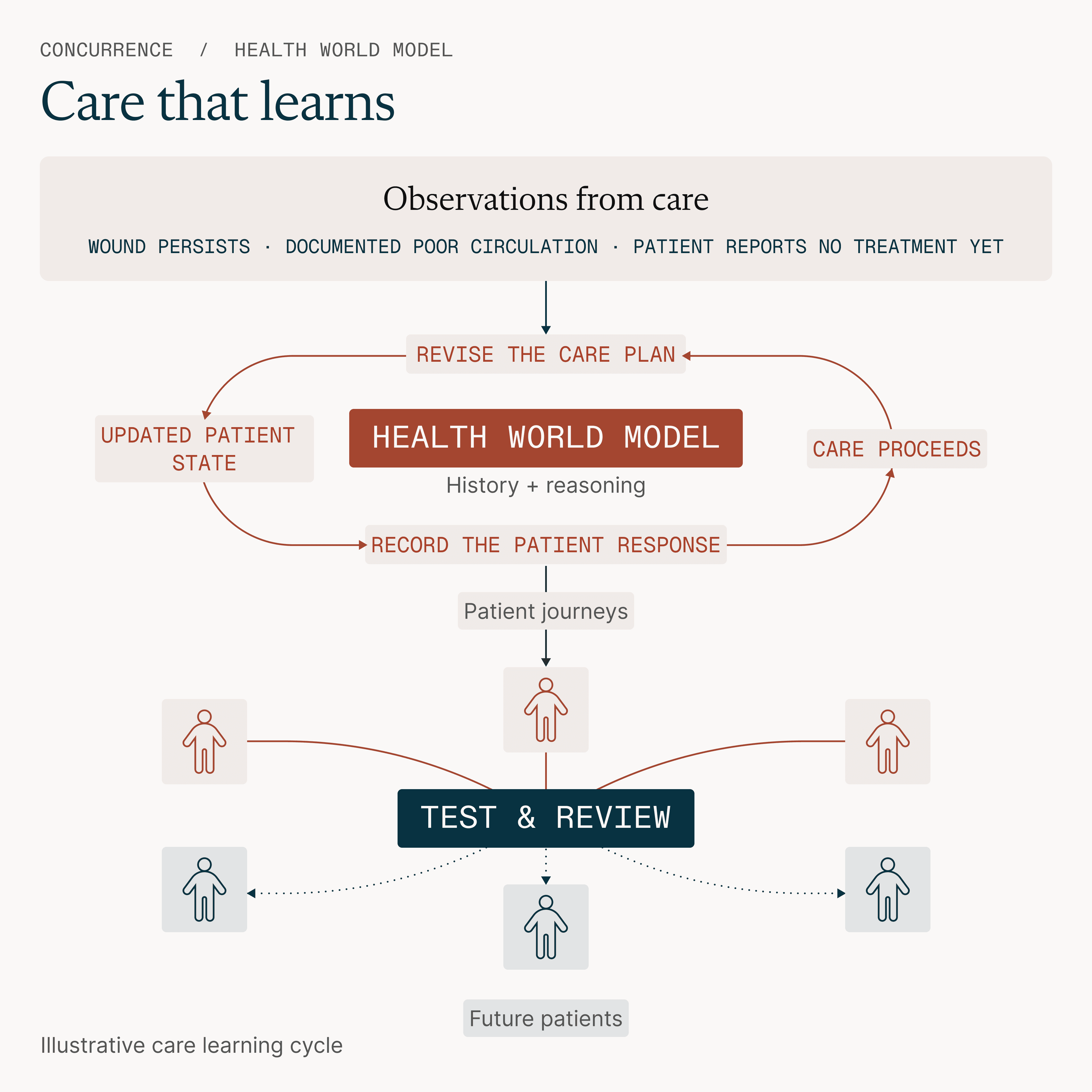
- Know what the evidence says and where it came from. Every observation must be matched to the right patient and understood in context: when it happened, when it was learned, and whether it was later corrected. Wound assessments, vascular evaluations, and clinician notes remain distinct. Resolving disagreements requires checking which source is authoritative for that information and when it was recorded.
- Revise the patient picture as new information arrives. When a vascular assessment documents poor circulation or a wound check shows persistent infection, the model connects those findings to what is already known and updates the current picture. Earlier evidence and corrections remain traceable, while unanswered questions stay visible alongside the new information.
- Use that revised picture to reconsider ongoing care. When a specialist documents findings that change the significance of a wound's course, the teams and applications responsible for treatment, monitoring, and follow-up can revisit the affected work. Each retrieves the appropriate context and acts under its own rules and permissions, carrying forward the updated evidence and the reason for the review.
Working With the Systems You Already Use
Concurrence is committed to supporting healthcare organizations across clouds and major data platforms, building on the infrastructure and systems our customers have already chosen. Patient context stays reusable as applications or underlying AI models change.
Your source systems retain their own records, and configured integrations bring selected information into a shared patient context. Applications connect through a software interface to use it; writing updates back to clinical systems is a separately configured connection.
- Existing workflows use revised context. Monitoring and outreach workflows can retrieve updated clinical instructions to reconsider next steps.
- New programs inherit the context already in place. A follow-up initiative can build on existing identity links, source connections, patient history, and the reviewed care plan, avoiding repeated connection, matching, and reconstruction work. It still maintains its own questions, contact schedule, permissions, and escalation rules.
Learning From One Patient to Improve Care for Many
The Health World Model keeps an evolving picture of each patient alongside clinical decisions, documented reasons, outreach attempts, and subsequent care. These connected histories form patient trajectories. Across comparable trajectories, an organization can spot a pattern worth testing. Over time, that could turn routine follow-up into evidence for which contact methods help patients receive care.
For example, for a defined group needing ongoing wound care, an organization could test evening text outreach against daytime calls for routine follow-up. A fair evaluation would track replies, attended follow-up visits, and time to recommended treatment, because a response alone does not prove treatment happened. If the results support both better engagement and faster care, a care-team-reviewed approach can be reused for patients whose circumstances fit, with continued checking as more trajectories accumulate.
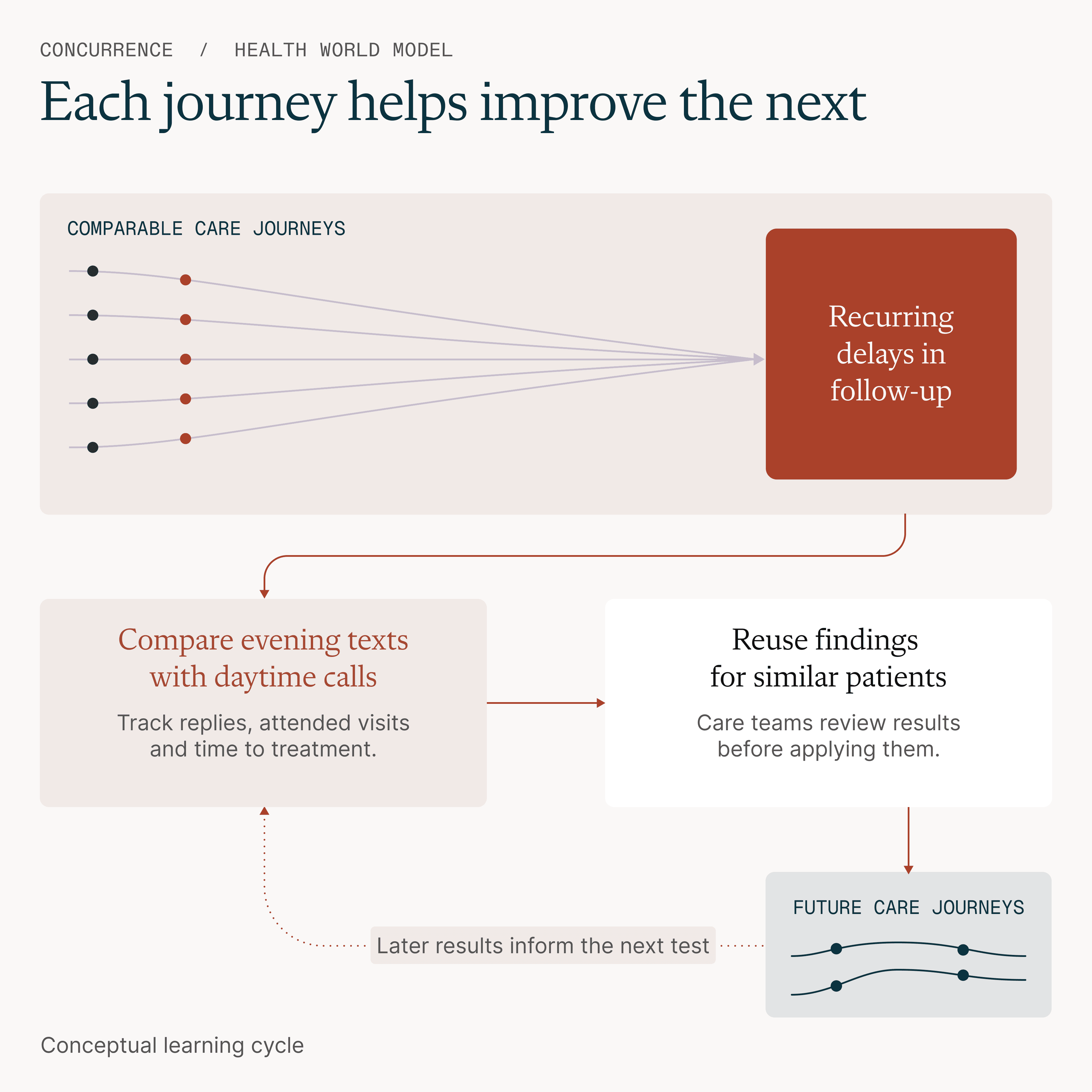
Future patients benefit from methods the organization has learned and tested, and later trajectories help refine them. The ambition is millions of patients getting care informed by what earlier care taught the system.
Building Toward Predictive Care
Patient context can also inform simulations used to test an agent's conversations and workflow behavior. For example, a team could test whether an agent uses updated clinician instructions during follow-up.
The HWM enables digital twins that combine patient context with additional validated clinical models to explore possible health outcomes. Those models would require evidence for how treatments affect outcomes, along with careful estimates of uncertainty.
That is the ambition behind the Health World Model: a future where care teams can anticipate how a patient's health may unfold and explore what different care choices could mean for them. When that understanding is paired with what an organization learns from past trajectories, the same foundation can benefit the patients who come next.
See how Concurrence puts patient context to work across care workflows. Book a demo.