Deploy where your data already lives.
Concurrence runs on Microsoft Azure in your region and writes its data into storage you own, where Microsoft Fabric and Azure Databricks read it in place. No new cloud, no second data platform.
Partnership announced
Read the announcement on PR NewswireMicrosoft partner · Built on Azure · Transactable on Microsoft Marketplace
Concurrence connects the data your healthcare workflows need and builds applications that work with your existing Azure environment.
Concurrence connects the data your healthcare workflows need and builds applications that work with your existing Azure environment.
 Built on Azure
Concurrence runs on Microsoft Azure in your region and writes its data into storage you own, where Microsoft Fabric and Azure Databricks read it in place. No new cloud, no second data platform.
Concurrence is transactable on Microsoft Marketplace. Purchase through your existing Microsoft agreement, consolidate billing on your Azure invoice, and apply eligible spend to your Microsoft Azure Consumption Commitment (MACC).
Every Concurrence workflow generates interaction-level data that enriches your understanding of the patient, helping you discover which care pathways produce the best clinical and operational outcomes.
Concurrence writes to your Azure Data Lake Storage, which stays private and encrypted with your own keys.
Agents read patient context only from the tables you choose to share, whether in your Fabric lakehouse or Unity Catalog, and every user and data grant is managed through Microsoft Entra ID.
Concurrence tables appear in your Fabric lakehouse through OneLake shortcuts, with no copies and no new pipelines. Agent activity and patient outcomes flow into Power BI through Direct Lake, so leaders see results in the reports they already use.
Concurrence tables land in your Azure Databricks workspace and are governed through Unity Catalog, so your teams work with them the same way they work with the rest of your data.
Mirrored Azure Databricks Unity Catalog lets Fabric read Concurrence tables governed in Databricks, without duplicating them, so both teams work from a single source of truth.
Concurrence calls Microsoft Foundry models over a private endpoint, in your own Foundry deployment or ours, so every call stays in your region.
The Concurrence runtime is built on Azure Kubernetes Service, Azure Database for PostgreSQL, and Azure Event Hubs, giving you the scale, reliability, and governance you expect from Azure.
Component 1
A longitudinal view of the patient, built by unifying every source of healthcare data into a single foundation: EHR records, claims, labs, device data, scheduling, prior conversations, care plans, consent and preferences.
Component 2
Concurrence deploys AI-powered workflows across the patient and clinician journey (intake, scheduling, outreach, documentation, referrals, follow-up, etc.), each with access to the living context in the Health World Model. This lets your organization scale the judgment of expert clinicians and generate interaction-level data that has never been captured.
Component 3
From this data, Concurrence identifies Patient Trajectories that connect specific interventions to specific outcomes. Across millions of them, your organization discovers which care pathways produce the best outcomes for each population.
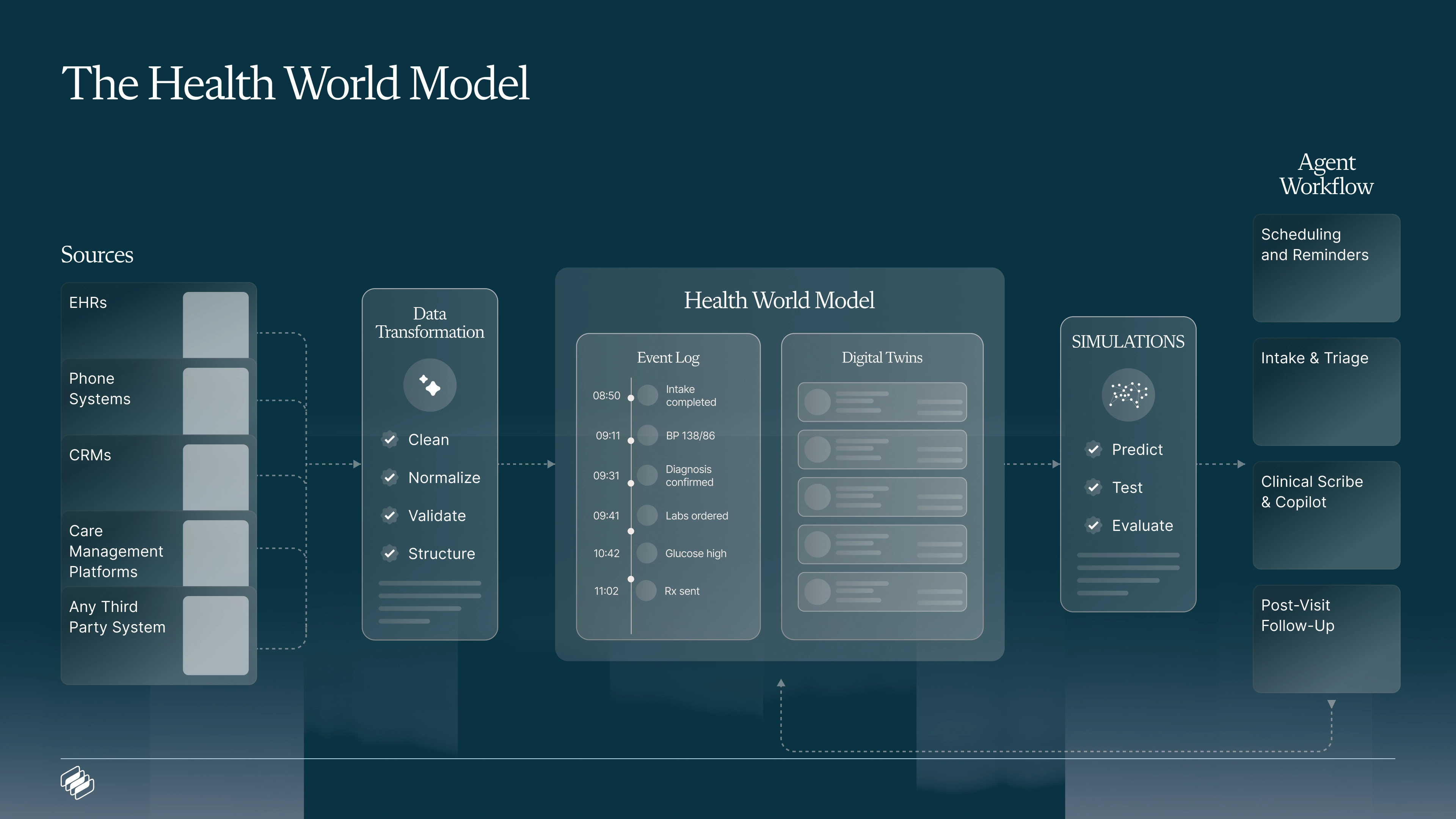
Simulate care workflows before rollout.
Create digital twins of every patient in your Health World Model and train your workflows across millions of simulated scenarios. We hydrate your environment with synthetic patient data to test realistic scenarios, edge cases, and user experience before release. Agents must prove their reliability on accuracy, empathy, and harm prevention before a single real deployment.
Microsoft Marketplace
Concurrence is available through Microsoft Marketplace via private offer. Transactions are eligible to count toward your Microsoft Azure Consumption Commitment (MACC). No separate infrastructure contract or migration project before value.
View on Microsoft Marketplace
Concurrence built a GLP-1 health coach for Hims & Hers that used models on Microsoft Foundry for coaching conversations and longitudinal patient memory. Before release, Concurrence ran simulated conversations across different synthetic patient populations and scenarios to evaluate the coaching experience.
Concurrence built a GLP-1 health coach for Hims & Hers that used models on Microsoft Foundry for coaching conversations and longitudinal patient memory. Before release, Concurrence ran simulated conversations across different synthetic patient populations and scenarios to evaluate the coaching experience.
Security & compliance
Independent assessment evidence and deployment-specific controls. Review eligible services, model processing terms, and BAA coverage for your Azure environment.
Visit our security page
Certified for the Concurrence platform. Review the certified scope against your Azure deployment.

PHI processing requires an executed BAA, eligible Azure services, and the required security configuration. Review model-specific retention and processing terms for your selected endpoints.

An independent report covers Security, Availability, and Confidentiality. Review its system boundary and period against your Azure deployment.

EU/DE data residency deployed in production.
Your storage is the system of record. Hosting location and model processing location are separate: Azure regional, Data Zone, and Global deployment types have different processing boundaries. Review the selected model endpoints, routing, and fallback settings with your security team.
Identity through Microsoft Entra ID, customer-managed keys in your Azure Key Vault, and Concurrence audit logs delivered to your Azure Monitor. Deployed in your own subscription, your existing governance applies on day one.
We enable read and write integrations with leading EHR and care delivery platforms using industry standard HL7v2 and FHIR interfaces. Based on your team’s use cases, we will scope out the correct integration mechanisms and endpoints. Our team brings knowledge from building 100+ health system vendor integrations.











Concurrence is a healthcare data and AI platform that runs on Microsoft Azure. It unifies patient data into a Health World Model, deploys AI-powered workflows across the patient and clinician journey, and identifies Patient Trajectories that connect specific interventions to specific outcomes.
Yes. Concurrence Data and AI Platform is listed on Microsoft Marketplace and is available through a private offer. Concurrence was formerly known as Amigo, and the listing currently shows Amigo AI as its publisher.
The listing carries the Azure benefit eligible badge, so eligible purchases made through Marketplace in the Azure portal count toward your Microsoft Azure Consumption Commitment. Pricing, purchase options, and commitment eligibility depend on the current listing and your agreement with Microsoft.
There are three options: a dedicated Azure subscription in your region managed by Concurrence, an Azure managed application in your own subscription, or a shared Concurrence environment in your region with each customer isolated in layers.
Yes. With Microsoft Fabric, Concurrence tables appear in your lakehouse through OneLake shortcuts without copies, and outcomes flow into Power BI through Direct Lake. With Azure Databricks, Concurrence tables land in your workspace and are governed through Unity Catalog. If you run both, mirrored Azure Databricks Unity Catalog lets Fabric read the same tables.
Your storage is the system of record. Hosting location and model processing location are separate: Azure regional, Data Zone, and Global deployment types have different processing boundaries. Review the selected model endpoints, routing, retention, and fallback settings for your deployment. PHI processing requires an executed BAA, eligible services, and the required security configuration; a private endpoint alone does not establish in-region inference or assessment coverage.
Learn more about the Concurrence platform, security and compliance, and global availability.